
Feed the soil,
not just the plant.
Chemical fertilizers work fast and wear out fast. Organic manure works slowly — and builds something that does not wear out: fertile, living soil. Our cow dung compost and goat manure come from the same agricultural belt where we grow our makhana. Same district. Same values.

The honest comparison
Chemical fertilizers are not wrong — they were necessary to feed billions. But the picture over twenty or thirty years is very different from the picture in year one.
| Factor | Organic Manure | Chemical Fertilizer |
|---|---|---|
| What it nourishes | The soil ecosystem | The plant directly |
| Nutrient release | Slow and sustained — months | Fast, short-term — weeks |
| Soil structure over time | Improves every season | Gradually hardens and acidifies |
| Microbial life | Promotes earthworms, bacteria, fungi | Can deplete over repeated use |
| After 5 years | Soil improves — needs less input | Soil may need more and more |
| Safety | Non-toxic, child and pet safe | Risk of runoff, groundwater harm |
| Cost over time | Stable or reduces | Typically increases |
The core argument: chemical fertilizers feed the plant. Organic manure feeds the soil. The soil then feeds everything — forever.
The long-term soil builder
Cow dung has been the foundation of Indian agriculture for millennia — not out of habit, but because it works. Fully composted (not fresh), our cow dung compost has gone through the heat of decomposition that kills weed seeds and pathogens. What remains is a dark, crumbly, mildly earthy material that improves almost any soil it touches.
NPK analysis: approximately N 0.6% / P 0.2% / K 0.5% — plus trace elements including Zinc, Copper, Boron, Iron, and Manganese that most fertilizer labels do not even mention.
Builds organic carbon
Organic carbon is the measure of how alive your soil is. Every application of cow dung compost raises it — making soil easier to dig, better at holding water, and more hospitable to earthworms and beneficial bacteria.
Slow-release nutrition
Unlike urea or DAP, which release nutrients in a short burst (and risk burning roots), compost breaks down gradually over 3 to 6 months — feeding plants at the rate they actually need.
Micronutrients included
Beyond the NPK numbers (N: ~0.6%, P: ~0.2%, K: ~0.5%), our cow dung compost contains measurable amounts of Zinc, Copper, Boron, Iron, Manganese — the trace elements that chemical fertilizers routinely omit.
Best for fruit trees and beds
Works particularly well for mango, lemon, guava, papaya, and long-season vegetable beds. Mix into the top 6 inches of soil or use as a thick mulch layer.
Higher potassium, faster action
Goat manure has roughly 0.9% Potassium — nearly double that of cow dung compost. Potassium is the nutrient that governs flower formation, fruit development, and disease resistance in plants.
Pellet form — easy to handle
Goat droppings are naturally dry and pelletized. They don't clump, don't smell much, and are easy to measure and spread without making a mess. Good news for terrace gardeners and flat-dwellers.
Faster decomposition
While cow dung takes 3 to 6 months to fully break down, goat manure typically works its way through in 2 to 3 months — making it better for seasonal crops where you need results before the next planting cycle.
Safe for containers and pots
Lower moisture content means lower risk of anaerobic rotting in containers. Add 10–15% goat manure to your potting mix for vegetables like tomatoes, chillies, and leafy greens grown in pots or grow bags.
The terrace gardener's choice
Goat manure has a higher potassium concentration than cow dung — and potassium is the nutrient responsible for fruit development, flowering, and disease resistance. For anyone growing vegetables or flowering plants in pots and grow bags, this difference matters.
NPK analysis: approximately N 0.7% / P 0.3% / K 0.9%. Enriched with microbial activation to speed up nutrient availability. The pellet form means no mess, easy measurement, and almost no odour — making it genuinely usable in a flat.
How to use each one
Practical guidance — not vague instructions like "apply as needed."
Cow Dung Compost
- 1New beds: Mix 2–4 kg per square metre into the top 20 cm of soil before planting.
- 2Fruit trees: Apply 5–10 kg per tree in a ring around the drip line. Water well after.
- 3Lawn / grass: Spread 1–2 cm as a top dressing. Water in.
- 4Potting mix: Replace up to 30% of your potting mix volume with compost.
Enriched Goat Manure
- 1Vegetables: Mix 100–150g per pot (about a large fistful). Blend into the top 5 cm.
- 2Flowering plants: Side-dress with 50–80g per plant once a month during the growing season.
- 3New planting: Add a 2–3 cm layer to planting holes before setting seedlings.
- 4Quick boost: Dissolve 200g in 10L of water, let sit overnight, use as a liquid feed.
Order now
Shipped from our Processing & Logistics Centre, Sonepur, Saran (NH 19). Packed in sealed bags to prevent moisture during transit.
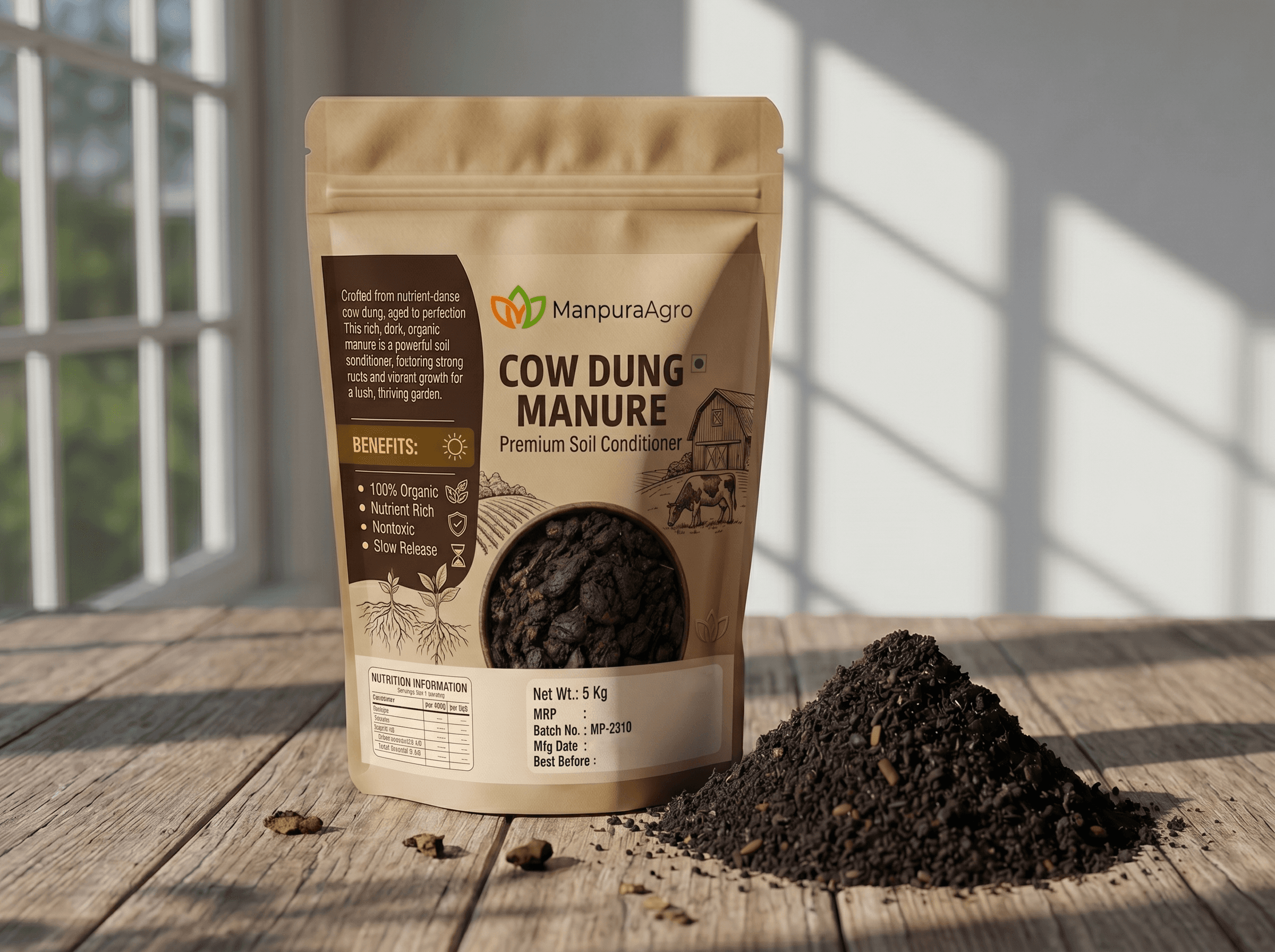 100% Organic
Premium Cow Dung Manure
Fully composted cow dung — not fresh, not semi-processed. The composting process eliminates weed seeds and pathogens. What you get is dark, crumbly, odour-mild organic matter that improves any soil it is mixed into. NPK: N 0.6%, P 0.2%, K 0.5% plus trace elements.
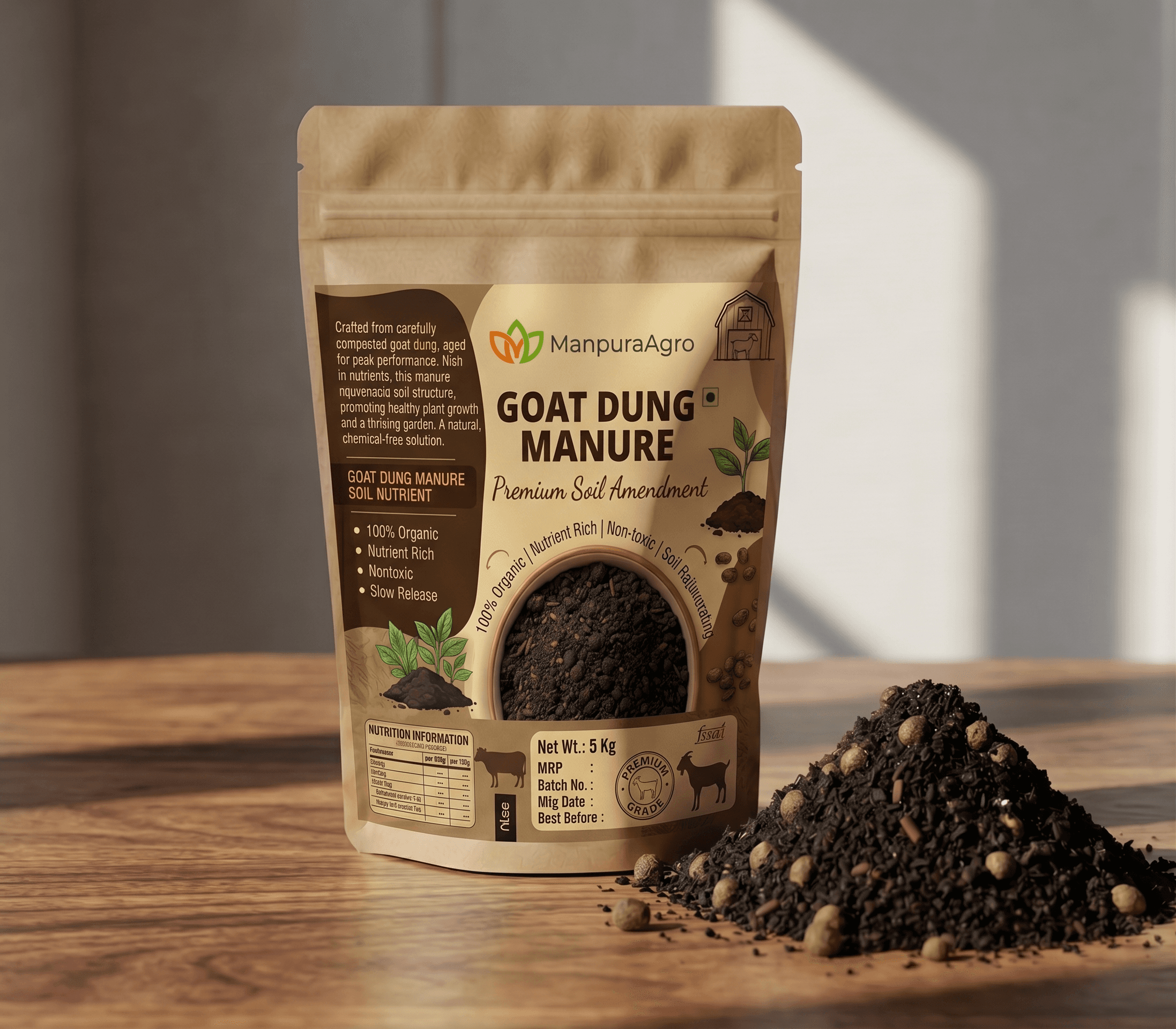 Nutrient Rich
Enriched Goat Dung Manure
Naturally pelletized — goat droppings are dry and firm by nature, not processed into pellets. Higher potassium than cow dung (K 0.9%) which matters for flowering and fruit set. Virtually odourless. NPK: N 0.7%, P 0.3%, K 0.9%. Works faster than cow dung compost — good for seasonal crops.